


Pat Finucane – Lest We forget
The 21st anniversary of the UDA murder of Belfast solicitor Pat Finucane will soon be upon us.
The assassination of Pat Finucane took place on the 12th of February 1989. The Belfast solicitor received multiple gunshot wounds whilst being attacked in front of his wife and children as they sat down to enjoy dinner. Official history tells us that this gruesome murder was the act of the UDA but it was in fact carried out by a number of UDA members who were also British security force agents, including RUC Special Branch agent Ken Barrett who was the trigger puller.
In a week where we have been told that the UDA has decommissioned its weapons, it is important to remember the central issue surrounding Pat Finucane's death. That central issue is organised state murder, an issue which many commentators would like to ignore, or even deny took place.
Irish journalist Henry McDonald (a seeker of “clarity and truth”) tells us in the Guardian this week that the UDA, the biggest loyalist paramilitary group in Ireland, has decommissioned all its weapons.
See – “Ulster Defence Association destroys its illegal weapons”
http://www.guardian.co.uk/uk/2010/jan/06/ulster-defence-association-destorys-weapons
Henry McDonald is the Guardian’s Ireland correspondent and the “clarity and truth” moniker I bestow upon him is a quote from his book ““Gunsmoke” And Mirrors – How Sinn Fein dressed up defeat as victory”. Readers can see my review of “Gunsmoke” here –
http://www.fadooda.com/index.php?itemid=141
At the start of “Gunsmoke”, McDonald states that his journalistic motivations are based on “securing a future based on clarity and truth” (see the preface to the book). This aspiration is perfectly laudable except for the fact that, in my opinion, McDonald never goes far enough down that truth seeking road to get anywhere close to the final goal. McDonald never mentions in “Gunsmoke” that in 1976 he was sworn in as a junior volunteer in the ultra Stalinist Official IRA. The Official IRA was the armed wing of Official Sinn Féin (which subsequently became the Worker’s Party) and was the sworn enemy of Provisional Sinn Féin and the Provisional IRA.
Some 13 years later, in 1989, McDonald, now working as a journalist, can be found attending a Workers Party celebration at the party’s Dublin headquarters after its successes in elections that year. Thus, given his history of either direct militant involvement, or subsequent latent support, for Official (ie Stalinist) Republicanism, the question must be asked as to whether McDonald allows his former political allegiances to colour his judgement. For, on page 30 of the hardback version of “Gunsmoke”, he makes the astounding assertion that allegations of structured collusion between loyalist paramilitaries and the British security forces are untrue
“…if one examines coldly and objectively the casualties of war in the North of Ireland, the notion of a centrally directed, structured and state run policy of collusion does not stand up to scrutiny.”
Bearing in mind that “Gunsmoke” came out in 2008, this is an incredible statement for a senior Guardian journalist to make. In fact, I would go further and argue that it is an unacceptable statement for a Guardian journalist to make.
The centrally directed intelligence structure that McDonald is looking for is right there in front of him if he would only care to look. There are actually some excellent Guardian journalists who can help explain this structure to him if needs be. Unless, of course, McDonald is denying that Britain’s ‘Secret Service’ agency MI5 ran agents and had overall control of covert military and policing operations in Ireland. If he is denying this, he is actually denying a fact which senior RUC Special Branch officers continually complained about. Namely that MI5 was in charge and not them.
It is true that for a brief period in the early 1980s, the RUC, under Sir John “Jack” Hermon was given a far more proactive role in covert operations but this ball was taken from them when their undercover units began their far too clumsy Shoot To Kill policy. It was not a journalist but Belfast solicitor Pat Finucane who did most to end that short lived period of “police primacy” by his brilliant legal footwork in the courts. It is no accident, therefore, that Pat Finucane then became the prime target of MI5 and RUC agents.
So can we be clear about this? MI5 had a central structure in place and worked in conjunction with RUC Special Branch in running agents and informers. The agents within loyalism that these powerful and covert structures were running were not pieces on a chessboard but very often hardened sectarian killers. This intelligence structure then decided to help rearm a moribund and demoralised loyalist movement. This same central structure then gave the UDA’s intelligence gathering system a complete overhaul by passing on hundreds of RUC intelligence files to a former British soldier (and convicted torturer of Catholics) - the UDA man Brian Nelson.
The removal of the UDA’s out of date and unstructured files and the provision of new files and office equipment is a key moment in the collusion paradigm. Roads were cleared of normal checkpoints and a British army helicopter followed proceedings from above. This was a joint RUC/MI5 operation, which Brian Nelson describes very thoroughly in his diary. Not one covert operations operative from that time has ever denied the veracity of Nelson’s description, which is backed up by testimony from other loyalists. These are incontrovertible facts.
Thus, the above centralised structure (a revamp of an earlier 1970s structure) was in place by the time we get to the UDA murder of Pat Finucane in 1989. Moreover, we now know that the most significant arms dumps containing weapons from South Africa that were used in the "revamped" loyalist murder campaign were provided by agents like that same Brian Nelson to a UDA “Brigade” staff, which was itself working hand in hand with the police and British intelligence. Presumably, Henry McDonald believes that this huge logistical operation was carried out by UDA members who just happened to be British agents and who also just happened to bump into each other in various places between Belfast and Pretoria, decided on the spur of the moment to buy a huge weapons arsenal and then forgot to mention it to their MI5 and police handlers. Guardian readers, never mind the people of Ireland, do not deserve that puerile level of argument.
A more rigorous search for clarity and truth by McDonald would show that the overall commander of the UDA at the time, Tommy Lyttle, was subsequently outed as an RUC spy. Indeed, it is a bitter irony that UDA leader and RUC agent Lyttle, who oversaw the importation of the South African Armscor weaponry via Brian Nelson and another British agent Charlie Simpson, also commanded the Belfast unit of the UDA who murdered Pat Finucane. It goes almost without saying that the quartermaster who supplied the weaponry for Finucane’s murder (William Stobie) was also working for the RUC.
We can see then how McDonald’s dismissal of the idea of organised collusion possibly leads him to omit any mention of the fact that a significant chunk of the UDA’s armoury was provided by agents of the British state in his UDA decommissioning report for the Guardian this week. Perhaps for the same reason, he also omits to mention that leading members of RUC Special Branch and British military intelligence have known all along about the location of the most important UDA arms dumps.
In fairness to Henry McDonald, he is simply applying the journalistic practice used by most Irish journalists. This practice has amounted to an Emperor’s New Clothes policy of looking the other way when the question of the British state’s murder by proxy campaign is mentioned. Or worse, Irish journalists have simply followed McDonald’s own example by actively arguing that collusion did not happen. Thus, the senior police, army and government mandarins who manipulated the loyalist marionettes from behind the arras of the British Crown’s prerogative have been vanished from the story. They do not exist.

Rosemary Nelson - another human rights solicitor murdered by state sponsored loyalists
Those brave souls who cried out that the British government’s policy of murder by proxy gangs was nakedly clear were very often ostracised for their troubles, lost their jobs, or became the subject of vilification strategies. And lest we forget, Pat Finucane (shot by a police agent in his kitchen in front of his wife and children), Rosemary Nelson (blown up by the RUC Special Branch sponsored LVF whilst in her car) and Martin O’Hagan (shot by the RUC Special Branch sponsored LVF as he walked home from his local pub) were all primarily involved in seeking to expose collusion between the British state and loyalist paramilitaries. It is worth mentioning that Martin O’Hagan was also an active member of the Official IRA in his day but, unlike Henry McDonald, he took a decision to expose the collusion he discovered in his work as a journalist, despite being no friend of Provisional Sinn Féin.
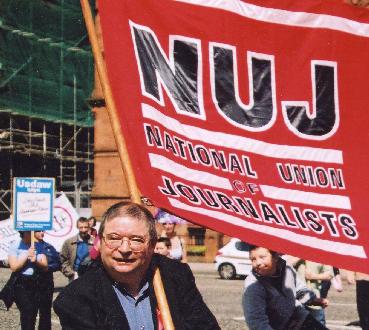
Martin O'Hagan - An ex Official IRA man who sought to expose collusion
I regard the refusal of Irish journalists to acknowledge collusion between the British state and loyalists killers as a scandal and in a perverse way, this scandal has been highlighted by the recent furore over renewed economic and trading ties with Libya. Quite correctly, the Libyan regime has been pressured by the news media over its supply of semtex plastic explosive and money to the Provisional IRA and, if memory serves me correctly, Colonel Gadaffi was “door stepped” by a BBC journalist just before Christmas on this issue.
Compare this with Irish journalism’s silence over British arms to loyalists. Margaret Thatcher was the commander in chief who gave the green light to British intelligence services to use loyalists as a proxy force. Has she ever been door stepped on this issue? Would an Irish journalist even have the temerity to do so?
Loyalist killers and collusion are not the problem. It does not exist. If it did, it would mean that Irish republicans, at the very least, had a legitimate point. And there, perhaps, is the rub.
The collusion scandal is as big as the Catholic church child abuse scandal because what is at issue here is organised state murder and until this issue is addressed, and the full truth acknowledged, it will continue to fuel a groundswell of bitterness which, in my view, helps to sustain those who wish to destroy the peace process.
The British state’s collusion with loyalist killers (many of whom were motivated by nothing more than a feral hatred of Catholics) is the ultimate test for any writer or journalist searching for a future in Ireland based on clarity and truth.
I ndil cuimhne - In memoriam - Pat Finucane 1949 - 12 February 1989